




Fair Oaks is one of the most established unincorporated communities in Sacramento County, with a character shaped by decades of residential development along the American River Parkway. The tree canopy here runs deep, the lots tend to be generous, and a meaningful share of the housing stock dates back to the 1950s through the 1970s. That history shows up directly in the HVAC systems we find when we arrive for a service call, from original duct layouts designed for a different era of equipment to systems that have been added onto, modified, or replaced piecemeal over the years.
Airmech Heating and Air Conditioning handles the full range of AC repair needs for Fair Oaks homeowners. We diagnose and repair refrigerant leaks, failed capacitors and contactors, blower and condenser fan motor issues, frozen evaporator coils, thermostat problems, and condensate drainage backups. Whether the system is a 30-year-old unit that has been well maintained or a newer replacement installed in an older home with legacy ductwork, we approach every job with the same thoroughness and honesty.
We walk you through what we found before we start any work, give you a clear cost picture, and let you decide how to move forward. That is how every visit goes, no exceptions.
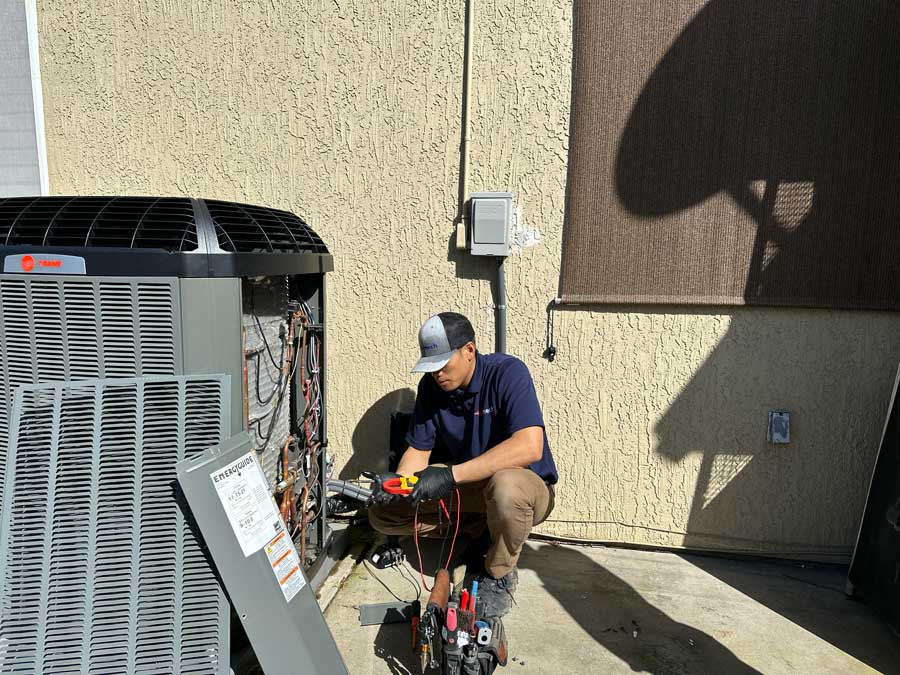
Fair Oaks summers are hot, and the mature tree canopy that makes the community so livable can also make it harder to notice when a system is struggling until the problem is already serious. Watch for these warning signs.
The shade from established oaks and elms can keep indoor temperatures feeling manageable even when the system is underperforming, which means problems sometimes go unnoticed longer here than in homes without tree cover. If anything on that list sounds familiar, it is worth getting a technician out before the issue compounds.
Fair Oaks sits along the American River corridor, and that proximity creates a microclimate that behaves differently from the open valley floor communities to the south and east. Spring and early summer bring measurably higher humidity levels along the river corridor compared to surrounding areas, and that moisture load adds strain to AC systems in two specific ways. First, the system has to work harder to dehumidify the air in addition to cooling it, which increases runtime and accelerates wear on the compressor. Second, condensate drain lines in this area see heavier flow and are more prone to algae-related blockages that can back up and cause water damage if the drain has not been serviced recently.
The mature tree canopy that defines Fair Oaks is another factor that works against air conditioning systems in ways residents do not always anticipate. Oak pollen, seed casings, and leaf debris are relentless from late winter through early summer, and they pack into condenser coil fins with surprising speed. We regularly find outdoor units in Fair Oaks that are significantly more fouled than units of the same age in less-wooded communities nearby. That debris loading reduces the condenser’s ability to release heat and forces the compressor to run hotter and longer than it should.
Older homes with original or partially updated duct systems present a third layer of complexity specific to this community. Many Fair Oaks properties were built when natural ventilation and smaller square footage meant HVAC loads were modest. When those homes were remodeled or expanded over the decades, the duct systems were sometimes extended without being properly resized, leaving the equipment fighting against airflow restrictions it was never meant to overcome.

Earlier this year, we heard from Theresa, a homeowner near the Fair Oaks Village area. She had noticed her system was running almost constantly through the first real heat stretch of early June but the house was staying several degrees warmer than her thermostat setting. Her home was a remodeled 1960s ranch with an AC system that had been replaced about eight years prior.
When our technician looked at the outdoor unit, the condenser coil was heavily loaded with oak debris and pollen residue that had accumulated over what looked like at least two seasons without a cleaning. Airflow through the coil was severely restricted, and refrigerant pressure was reading low, pointing to a slow leak at the evaporator coil inside. The indoor coil had also developed a partial freeze as a result of the combined low refrigerant and reduced airflow, which was compressing what little cooling capacity remained.
We let the coil thaw, cleaned the condenser thoroughly, located and repaired the refrigerant leak, and recharged the system. Before leaving, we also checked the duct connections in the attic and found one separated joint above the hallway that had been pulling conditioned air into the attic space instead of delivering it to the back of the house. Theresa said the difference that afternoon was immediate and obvious. Getting multiple issues resolved in a single visit is something we aim for on every call.

Fair Oaks homeowners tend to be invested in their community and selective about who they let into their homes. We think that is a good thing, and we work to earn that trust on every call.
We are not a volume operation sending whoever is available to your door. We are a local team that cares about getting it right and about being the name you call the next time something comes up.


Here are answers to some of the questions we hear most often from Fair Oaks homeowners. If you have something more specific in mind, give us a call or book online any time through our 24/7 scheduling system.
The river corridor brings noticeably higher humidity levels to Fair Oaks compared to communities on the open valley floor. That means your AC has to remove more moisture from the air in addition to cooling it, which increases how hard and how long the system runs. It also means condensate drain lines see heavier flow and are more likely to develop algae blockages over time. Annual maintenance that includes a drain flush is especially important for homes in this part of the county.
June in Fair Oaks often combines moderate heat with elevated humidity from the river corridor, which can actually be harder on an AC system than dry triple-digit heat later in the summer. The system has to work harder to control both temperature and moisture simultaneously. If the system is already dealing with a dirty coil or low refrigerant, that combined load in early summer is often what exposes the problem first.
More often than the standard once-a-year guidance if your outdoor unit is near oak trees or other heavy-shedding vegetation. Oak pollen season runs from late winter into spring, and seed and leaf debris continues well into summer. We recommend at minimum an annual cleaning in early spring, and for properties with heavy tree cover, a mid-season check in July or August is worthwhile to see how much has accumulated since the spring service.
Very likely, yes. When a home is added onto without the duct system being properly resized, the equipment ends up fighting against airflow restrictions it was not designed for. This shows up as hot spots in newer additions, rooms that never quite cool down, and a system that runs constantly without hitting the thermostat setpoint. A duct assessment during a service visit can identify where the mismatch is and what the fix looks like.
Our membership plans are designed to keep your system in good shape year-round while saving you money compared to scheduling service a la carte. Plans typically include annual tune-up visits, priority scheduling when you need a repair, and member discounts on parts and labor. We will walk you through the specific options during any service visit or you can ask about it when you schedule online.